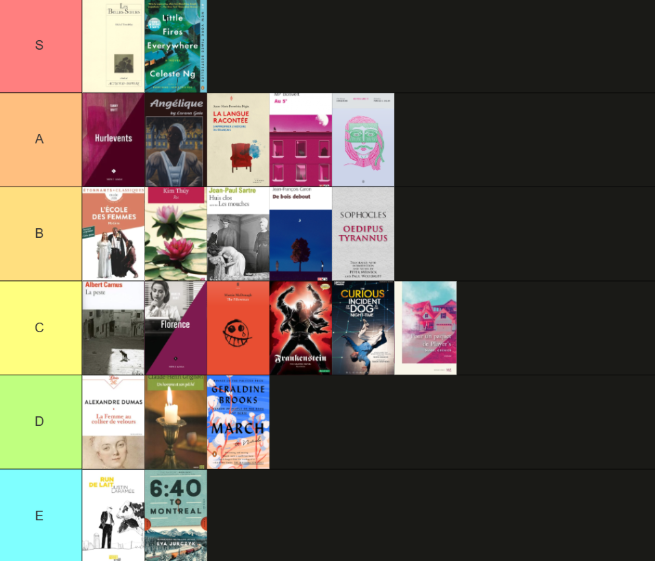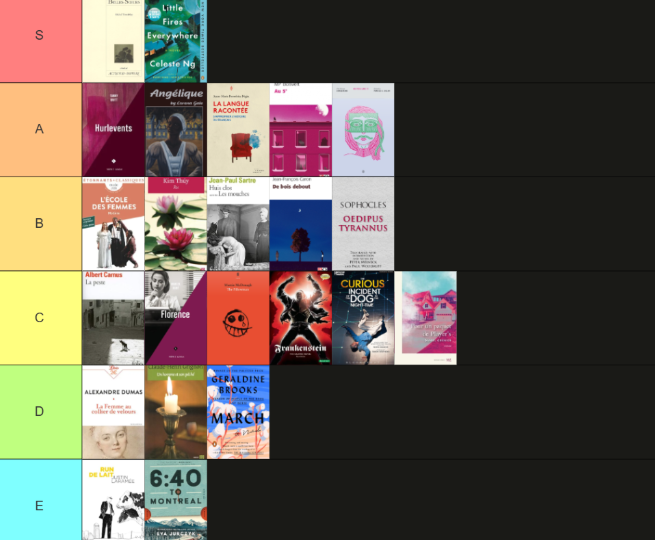

Ah, college required readings. Love them or hate them, I am forced to admit that some of these books were actually very interesting, while others… not so much. Since I am finishing college and I am finished with the required readings, I thought that I would do a good ol’ tier list of them to reflect on the highs and lows of trying to finish a book in the bus right before the test about said book. But before, let’s define each subjective rank that I will give these books:
S tier- I loved this book, I maybe would have picked it out on my own, and I didn’t mind or even liked (!!) talking about it in class and writing essays about it.
A tier- A solid book, maybe not what I would have chosen on my own, or there are a few flaws with it, but it was overall a good read.
B tier- It wasn’t the best, but overall not too bad. I will not think about this book ever again, but it did not make me suffer.
C tier- It really really wasn’t the best, but not the worst either. I will not think about this book again, and it kind of made me suffer to have to read it.
D tier- I disliked the book, and had a bad experience reading it, but it still could have been worse. Maybe the book had a few redeeming qualities.
E tier- I hated this book, I hated having to read this book and I will put a multigenerational curse on the author of this book.
So here are all of the books that I have read for college, in approximal chronological order:
First semester:
- La peste by Albert Camus, read for my “Oeuvres narratives et écriture” class. C tier.
This was the first book that I ever read for college, back when I still had a bit of life and motivation left in me. This book definitely had some interesting themes, but it was mostly very long. I can barely remember what happens in that book a year and a half after.
- La femme au collier de velous by Alexandre Dumas, read for my “Ouvres narratives et écriture” class. D tier.
I don’t remember a single thing about this book, maybe because I did not finish it. Maybe it is only so low because I associate it with the exam I had to do about it (writing fanfiction), which I was not a big fan of.
Second semester:
- Hurlevents by Fanny Britt, read for my “poésie, théâtre et écriture” class. A tier.
I read this entire play in one evening, and it had some pretty interesting themes and characters, but I wish that they had been more developed. Overall, I enjoyed reading it.
- Run de lait by Justin Laramée, read for my “poésie, théâtre et écriture” class. E tier.
It’s surprising that I hated this book as much as I did, because I usually like weird books about niche topics, but I fear that this was too weird or too niche because I had to force myself to read through it. I have forgotten almost everything about its actual content except for the part in which he describes his transformation into a cow, for some reason that has stayed with me (derogatory).
- L’école des femmes by Molière, read for my “poésie, théâtre et écriture” class. B tier.
The first 10-15 pages were absolute hell to get through, but once I got into it, it was surprisingly readable. By the end, I found myself almost enjoying the weird storyline. Some of its themes are also somewhat still relevant, so kudos to Molière for that.
- Angelique by Lorena Gale, read for my “Canadian Arts and Literature” class. A tier.
A very interesting story about the less well-known industry of slavery in Quebec, with a dangerous mystery at the center of it. My only complaint is that some parts of it felt more rushed or less developed.
- Un homme et son péché by Claude-Henri Grignon, read for my “Qu’est-ce qu’un classique québécois?” class. D tier.
I know that this is a classic and whatever, but it’s also surprisingly boring and so hard to get through. Some parts of it were interesting, but you have to dig through the rest to find them and it’s not a great experience.
- Les belles-soeurs by Michel Tremblay, read for my “Qu’est-ce qu’un classique québécois” class. S tier.
Funny, interesting, feminist, I was hooked. This play covers so many important topics, mostly related to women’s difficulties in society, but manages to strike a balance between that and funny little jokes perfectly.
- Ru by Kim Thúy, read for my “Qu’est-ce qu’un classique québécois” class. B tier
This is a very interesting tale and a different perspective from my own on Québec, and I like the way in which it is formatted. However, some moments were a bit unclear and I sometimes felt like the way that she was talking about her son’s autism was a little bit weird (“prisoner of his mind” and such).
Third semester:
- Les mouches by Jean-Paul Sartre, read for my “Comparaison d’oeuvres narratives” class. B? C? tier.
I honestly forgot every single thing about this book. That might be more on me than the book, but I can’t remember anything about it except that it was somewhat about Greek mythology I think? I read the whole book but it’s just blank in my mind.
- Florence by Marcel Dubé, read for my “Comparaison d’oeuvres narratives” class. C tier.
I was kind of hyped to read this book because I had read “zone” by the same author in high school and liked it, but this play was just very boring. If I wanted to hear about a tired office worker who wants a better life I’d just talk with my mother.
- De bois debout by Jean-François Caron, read for my “Comparaison d’oeuvres narratives” class. B tier.
Overall it was not too bad, but some parts of it were definitely more interesting than others. I also felt like the female characters could have been better written as to not just be plot devices.
- La langue racontée by Anne-Marie Beaudoin-Bégin, read for my “fondements de la langue française” class. A tier.
Now this is a weird and niche book that I can get behind. This book was clear and contained interesting stuff, but I might be biased because it is related to the field of studies that I am going to pursue at University. I cannot judge the entire book, though, because I did not read all of it, only the part that was assigned (though I do want to read the rest of it eventually).
- Au 5ème by M.P. Boisvert, read for my “fondements de la langue française” class. A tier.
I liked the idea of it, because I have rarely seen polyamory in fiction, especially with lesbian and transgender representation, but the execution of it could have been better in my opinion. Because of the short length of the book, it felt like some characters were not developed as much as others and some parts felt a bit rushed. The inclusive language took a bit of getting used to, but I actually find it quite nice.
- Oedipus Tyrannus by Sophocles, read for my “literary genres” class. B tier.
The language is definitely not easy, especially in the beginning, but the story is actually pretty interesting and drew me in by the end.
- As You Like It by Shakespeare, read for my “literary genres” class. A tier.
I never thought I would say something like that about Shakespeare, but this surprised me in a good way. Similarly to Molières and Sophocles, the language takes getting used to (and thank god for all the footnotes), but I actually really enjoyed the story and was fully invested by the end. I liked the gender-fuckery of it all (rip Shakespeare you would have loved drag queens), it’s almost gay if you squint and I like that. My research on it for my essay also somehow made me appreciate it even more.
- The Pillowman by Martin McDonagh, read for my “literary genres” class. C tier.
It had an interesting premise, but the short horror stories that the main character would tell were often not as interesting and well-crafted as the main plot in my opinion. I was also unsure of its characterization of the mentally disabled character.
- Frankenstein Graphic Novel by Mary Shelley and adapted by Jason Cobley, read for my “Perspectives in English Literature” class. C tier.
This is only my rating of this adaptation, as I believe the actual novel is better than it. It is a shorter, more digestible version of the story, but I think that it loses a part of its charm in the process. The art is just fine.
- The Curious Incident of the Dog in the Night-time (play adaptation) by Mark Haddon and adapted by Simon Stephens. C tier.
The story had some interesting moments, but the autistic character felt unrealistic in my experience (most autistic people are not just an amalgamation of all of the possible traits listed in the DSM-5).
Fourth semester
- Pour un paquet de Player’s by Daniel Grenier, read for my “projet créatif” class. C tier.
It had a very interesting concept, but the execution fell terribly flat. This book would have benefited from at least a hundred more pages. (Plus de Claude!)
- March by Geraldine Brooks, read for my “Long Fiction” class. D tier.
Most insufferable main character ever, can he stop his white savior complex please. I know that he is supposed to be a morally grey character, but even knowing this, I cannot stand to read for so long about him because I frankly do not care for him. I think that this type of story would have been way more interesting if it actually focused on the people of color. Its only redeeming quality is the ending when one of the said characters of color insults him a bunch.
- Little Fires Everywhere by Celeste Ng, read for my “Long Fiction” class. S tier.
I actually really liked reading this book and I felt like it both tackled important themes and also had a very entertaining plot. It is the type of book that I would have picked out on my own.
- 6:40 to Montreal by Eva Jurczyk, read for my “Long Fiction” class. E tier.
Nevermind what I said about March, this main character is somehow more insufferable. I absolutely hated this book with a burning passion. I have ranted about this book to basically everyone I know (sorry guys) and I never want to hear its name pronounced ever again once I’m finished with the semester.
I hope that you guys enjoyed my very biased, very subjective ranking of these books. Even if I didn’t like all of them, at least they broadened my reading horizons and got me out of my comfort zone, so I appreciated the experience.