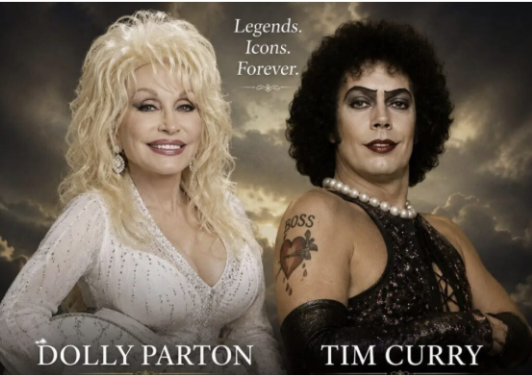

On August 25th, 2026, we lost two important figures in the arts: Dolly Parton and Tim Curry, both aged 80 years old. They were more than a country singer and an actor. These two icons helped marginalized communities have a place to be themselves in the world. In honor of their lives, this article explores some of their most well known influences on those communities.
Dolly Parton
Dolly Parton was a well cherished person, who was hard to ignore. Whether it was her blond wig, her extravagant outfits, or her philanthropy, Dolly seemed to be everywhere, and yet never could we accuse her of being arrogant as a result of all that attention.
She was born on January 19th 1946, in Sevier County, Tennessee, in a humble family of twelve children. Her musical career itself started when she was young; she wrote her first song when she was just five years old and started appearing in radio shows at around ten years old. Her career fully kicked-off after she moved to Nashville in 1964. She released her debut album, Hello, I’m Dolly in 1967, making her career almost six decades long. But starring in movies and singing songs was not all she did throughout her life. Parton was a devout Christian who took the second commandment: “love your neighbor as yourself” to heart, showing this devotion through her philanthropy and activism.
Her first major community-centered project was the construction of her theme park, Dollywood, in Pigeon Forge, Tennessee, in 1986. Her project created job opportunities for thousands of people in the region, which was previously only a small mountain town. Those jobs varied from janitor to baker to hotel manager. Dollywood is now the main employer of Sevier County, her home county, according to Fox Business.
However, that is not all that she did. On top of donating millions of dollars to various charities, Parton created the Dollywood foundation in 1988, which provided scholarships to keep students in schools in East Tennessee.
Most of you may also know of her Imagination Library, which was formed in 1995. As of today, the Imagination Library has donated “over 300 million free books to children around the world from birth to age five” (dollyparton.com/bio). The exact numbers, as of August 31st 2026, are 332,411,218 books donated to 3,197,250 registered kids (imaginationlibrary.com). She started this project to give the children of her county a chance to read. She often spoke about how hardworking and intelligent her father was, but because he was never able to learn how to read or write, Dolly Parton was marked by how much literacy can affect a person, from their self-confidence to the opportunities they may get. She started the Imagination Library as an homage to him and as a way to help children in need.
Now, through funding by Parton herself and local community partners in the United States, Canada, United Kingdom, Australia, and Republic of Ireland, her project has reached all those partnering countries. There is no limit as to how far this project can reach. The Imagination Library accepts donations from anyone who can donate. In Parton’s words:
“When I was growing up in the hills of East Tennessee, I knew my dreams would come true. I know there are children in your community with their own dreams. They dream of becoming a doctor or an inventor or a minister. Who knows, maybe there is a little girl whose dream is to be a writer and singer. The seeds of these dreams are often found in books and the seeds you help plant in your community can grow across the world.”
The Imagination Library has been open for 31 years now, and is hopeful to stay open and provide books for millions of children for many more years to come.
Parton has also spent years advocating for women’s rights, civil rights, and gay rights. Throughout the decades, she also openly denounced several recent anti-trans and anti-drag bills. In 2014, in an interview with Billboard, Parton talked about her queer fanbase and affirmed: “I think everybody should be allowed to be who they are, and to love who they love. I don’t think we should be judgmental” (CBC News).
Earlier even, in the mid 1980s when the AIDS virus was intensifying homophobia and and anti-gay stigma, Parton co-founded the production company that co-produced a documentary about the AIDS memorial quilt titled Common Threads: Stories From the Quilt (you can watch the full documentary on youtube by following this link: https://www.youtube.com/watch?v=qAT4-NDH8Xg).
During the 1990s, Parton even paid for the medical costs for one of her employees to transition. This fact was only revealed last week by one of her former editors at HarperCollins.
In 1991, Parton also released a song titled Family, where lyrics openly mention gay people, even as in the world of conservative country music, the term was practically taboo. This song, among many others, helped queer people feel seen without making huge, attention grabbing political statements.
She also advocated for gay marriages long before the United States Supreme Court made it a fundamental right in 2015, saying in 2009 one of her most famous quotes: “Sure, why can’t they get married? They should suffer like the rest of us do,” among other quotes later on.
In more recent years, Parton firmly spoke out against Tennessee’s ban on gender-affirming health care for minors and the state’s anti-drag laws. Her impact was such that the day before her death, a federal judge cited Parton as he struck down a Texas law that would ban drag shows in the state.
Dolly Parton was not a good person for fame. She was a good person simply because she could. She was humble and generous, to the point that she could’ve been a billionaire, but she chose to give it to those who needed it more.
Her legacy will live on for a while still, and we hope to honour her efforts by telling you about her and her accomplishments. A great quote to remember her by would be this: “The first step is always the hardest, but you’ll never know unless you try…”
Dolly Parton did a whole lot more than those three projects we presented to you. To learn more about her works, you can consult her personal website, as well as the Imagination Library’s website, both of which are linked in the sources below.
Tim Curry
Most people probably know Tim Curry from his role as the janitor in Home Alone 2, or if you are into the classics, as Pennywise in the It mini-series from 1990. You may also recognize him from his multiple voice acting gigs, such as Captain Hook in Peter Pan and the Pirates. Some people may know of the 1975 movie-musical called The Rocky Horror Picture Show, where Curry starred as Dr. Frank-N-Furter, a transvestite alien scientist. This was one of Curry’s most impactful roles, as queer communities assembled around this movie as a place to be themselves.
Born on April 19th 1946, Tim Curry discovered his love for the acting world when after the death of his father, he gained a scholarship to Kingswood School, Bath, where he started acting in school plays. He later studied drama and English at Birmingham University from 1965 to 1968.
In 1973, Curry was invited by one of his previous fellow cast members to audition for an experimental musical titled The Rocky Horror Show that would be performed at the Royal Court’s Theater Upstairs. Curry managed with little difficulty to win the role of Dr. Frank-N-Furter and the live show became a hit.
In 1974, The Rocky Horror Show got its own movie version titled The Rocky Horror Picture Show, once again starring Curry as the Dr. and still, 50 years later, remaining a cult phenomenon, especially among the queer and marginalized communities.
However, the movie and the following Broadway run were not actually successes.The movie was only successful in one location in Los Angeles and was withdrawn from its eight opening cities because of the very small audiences it attracted. The movie’s opening in New York City was even cancelled. The Broadway show closed its doors after only 45 performances.
It wasn’t until 1976, when the movie was distributed for the midnight screenings at the Waverly Theater in New York City that it started gaining traction throughout the United States. It is now considered the longest-running release in film history, still to this day being featured at midnight screenings
Members of the LGBTQ+ community made up a large part of the cult following of the movie. The musical itself was one of the very firsts to include characters who had fluid gender identities, such as Curry’s character, Dr. Frank-N-Furter. The members of the queer community identified with the embrace of sexual liberation and androgyny that was presented in the movie. The midnight screenings allowed for them to meet up and present themselves as they wanted, which aided in bringing visibility for the community around North America.
Tim Curry brought to life the character of Dr. Frank-N-Furter. He was the one who made the Dr. an icon of pop and queer culture, which in turn encouraged people to present themselves in a way they felt comfortable. More than 50 years later, his interpretation is still valued and viewed as an important part of pop culture.
Dolly Parton and Tim Curry were icons of their own rights and showed people that if you want to help others, you can. We will always remember them and their legacies, so remember to live your life to the fullest and keep being yourself.
Writer: Mia Bouchard; Editor: James Beaupré; Picture: The Daily Blog
Sources:
Britannica, 2026. The Rocky Horror Picture Show | Cult Film, Musical, History, & Cast. https://www.britannica.com/topic/The-Rocky-Horror-Picture-Show
CBC News, 2026. ‘People are people’: How Dolly Parton became an unlikely 2SLGBTQ+ icon, ally and advocate. https://www.cbc.ca/news/world/dolly-parton-gay-rights-9.7320874#:~:text=She%20spent%20decades%20championing%20women%27s%20rights%2C%20civil%20rights,%22I%20just%20want%20everybody%20to%20be%20treated%20good.%22
Dolly Parton. https://www.dollyparton.com/
Dolly Parton’s Imagination Library. https://imaginationlibrary.com/
Fox Business, 2026. How Dolly Parton transformed a small Tennessee town into a tourism empire. https://www.foxbusiness.com/media/how-dolly-parton-transformed-small-tennessee-town-tourism-empire
Larry King, 2016. Dolly Parton on supporting the LGBTQ community | Larry King Now | Ora.TV. https://www.youtube.com/watch?v=Fsq8P9n3hXY
People Magazine, 2026. Federal Judge Cites Dolly Parton in Striking Down Texas Ban on Drag Shows. https://people.com/judge-cites-dolly-parton-striking-down-texas-drag-ban-12069007
The Rocky Horror Picture Show (1975)
Tim Curry. https://timcurry.com/